Carbon-face pickleball paddles: surface and construction
Published on October 30, 2026 Reviewed October 30, 2026 3 min read
Text by the Fibre Tressée editorial team.
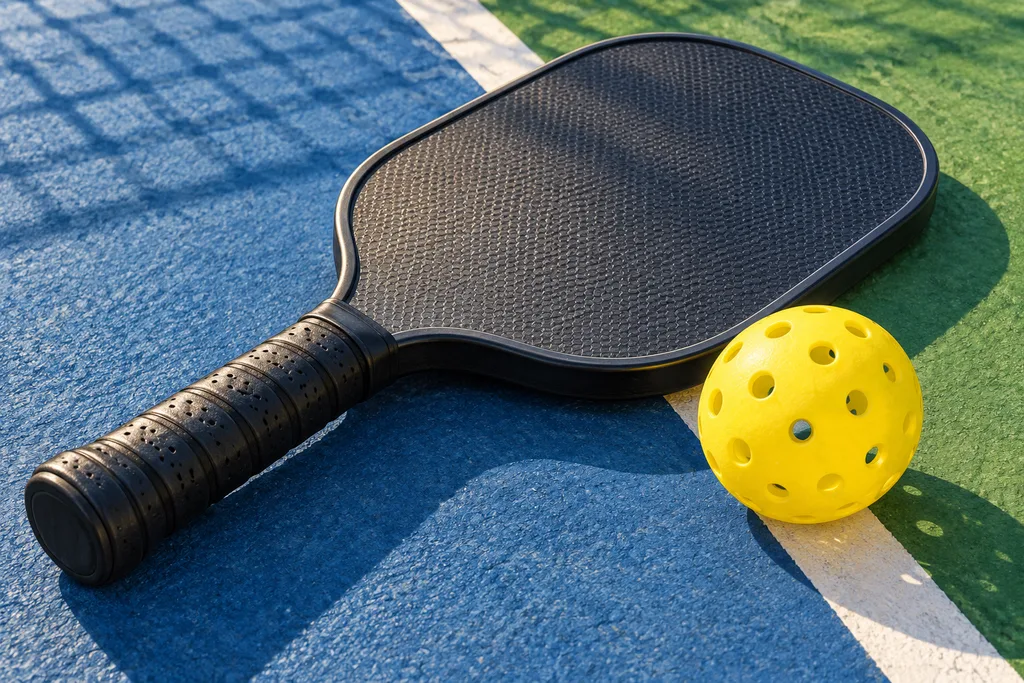
This article, “Carbon-face pickleball paddles: surface and construction,” proceeds in announced stages, and I will outline its thread right away. Understand the role of the carbon face in a pickleball paddle.
Up front: USA Pickleball launched a spin rate test on October 1, 2026: paddles certified after that date must pass it. The spin test procedure was released on July 15, 2026; until October 1, a paddle could still be approved with only the surface roughness and coefficient of friction tests. The USA Pickleball spin test uses PaddleVision, a two-camera system developed by the Swedish company Image Systems, and sets a threshold of 2,100 rpm that must not be exceeded.
The essential terms
First, let me clarify the vocabulary used in this talk.
Stringing surface
Area of the badminton racket occupied by the strings, intended to hit the shuttlecock.
To illustrate: the Laws of Badminton specify that the strings form a defined surface within the head of the racket.
A more developed definition awaits you in the entry Stringing surface.
Shaft
Part of the badminton racket that connects the handle to the head.
To make the notion tangible, the Laws of Badminton name the shaft among the components of the racket.
I refer you to the entry Shaft to go further.
What happens behind the scenes
On the rules side, here is what is established: the laws of badminton require the shuttlecock to have flight characteristics close to those of a natural-feather shuttlecock with a cork base covered with a thin layer of leather, whatever its material.
A framework to know: paddles already certified remain compliant with the standards of their certification period, despite the arrival of the spin test.
A framework to know: a badminton racket may not include any device allowing the player to substantially change its shape.
Note this provision: a regulation feather shuttlecock has 16 feathers fixed in the base.
What makes the difference
The criteria that follow will help you structure your thinking.
- Toray classifies the T700S among standard-modulus fibers (about 33-34 Msi), whereas its intermediate modulus fibers, such as the T800, are around 42 Msi: “T700” therefore does not denote a high-modulus fiber.
- Modern badminton rackets are made of a carbon fiber composite (graphite-reinforced plastic), sometimes supplemented by other materials.
- The string also influences the natural frequency of the racket — in the study, a Kevlar string gave a markedly higher natural frequency than synthetic gut, natural gut or polyester.
What does a carbon face change?
On the rules side, here is what is established: the Badminton World Federation (BWF) has authority to decide whether a racket complies with the specifications of the laws.
On the rules side, here is what is established: the laws of badminton limit the racket to 680 mm in overall length and 230 mm in overall width.
Note this provision: the badminton racket must be free of added objects or protrusions, except those used to limit wear, absorb vibration, distribute weight or attach the handle, which must remain reasonable in size and position.
What is deflection?
A framework to know: the strung area of a badminton racket may not exceed 280 mm in length and 220 mm in width, with a tolerance for the extension of the strings into the throat (35 mm wide at most, 330 mm in overall length).
In conclusion
Take the time to compare these benchmarks with your own needs, without rushing.
Related reading
- T700 carbon badminton racket: what you need to know — T700 in badminton rackets and in the rules set by the BWF. The sections offered are as follows: what organizes the topic.
- Allowed badminton racket dimensions: the limits set by the laws of the game — Check in a few measurements that a racket meets the official limits. In these pages, you will go through: how to use the list: the essentials.
- New paddle tests and spin rate: understanding the changes — See how official tests now regulate paddles with a textured face. The topics covered in turn are the following: what is established.
- Carbon frame and shaft: what the T700 label changes in badminton — Learn which parts of a badminton racket are affected by the advertised fiber. The topics are covered in turn: the essential terms.
Sources cited
- USA Pickleball lance son test de taux de rotation (The Dink Pickleball) —
- Laws of Badminton, spécifications de la raquette — Maximum racket dimensions (680 mm by 230 mm), strung area, ban on devices that change the shape, authority to rule on compliance. Checked on 2026-10-13.
- Fibres de carbone à module standard, intermédiaire et élevé (Toray) — Presents the T700S and T700G: the T700G offers higher modulus and adhesion and targets aerospace and high-end sporting goods. Checked on 2026-10-13.
- Racket (sports equipment), Wikipédia) —
- Experimental and Computer Simulation Studies on Badminton Racquet Strings (Sensors, 2023) — Study combining tests, finite elements and calculations, carried out on a carbon-epoxy frame. Checked on 2026-10-30.
Sources and verification
- This text rests on 5 sources: 1 official body or institution, 1 scientific publication, 1 press title and 1 manufacturer documentation.
- Facts checked against their sources on October 13, 2026.
- How sources are chosen and verified: Fact checking.