New paddle tests and spin rate: understanding the changes
Published on October 30, 2026 Reviewed October 30, 2026 3 min read
Text by the Fibre Tressée editorial team.
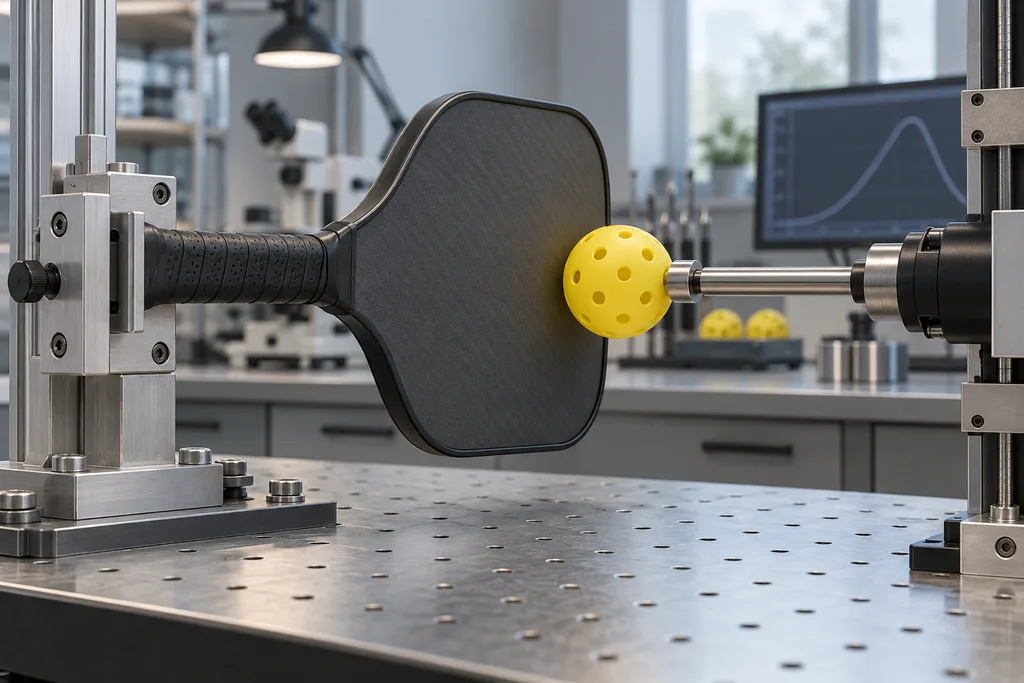
Dear readers, let us open “New paddle tests and spin rate: understanding the changes” by taking the time to set down each reference point. See how official tests now regulate paddles with a textured face.
At the outset: the spin test procedure was released on July 15, 2026; until October 1, a paddle could still be approved with only the surface roughness and coefficient of friction tests. Paddles already certified remain compliant with the standards of their certification period, despite the arrival of the spin test.
What is established
Let us pause on this measurement: Toray's T700S fiber has a tensile strength of 4,900 MPa (711 ksi) and a tensile modulus of 230 GPa (33.4 Msi); it is offered in tows of 6K, 12K and 24K filaments.
Look at this measured benchmark: in a 2023 study of a graphite frame blended with epoxy resin, higher tension (up to 34 lb) reduced string elasticity and shuttlecock speed, while lower tension (20 lb) gave a higher rebound speed.
Let us rely on this verified value: at Toray, the high modulus fibers of the M series, from the M35J (49.8 Msi) to the M60J (85.3 Msi), target the applications where stiffness matters most, including high-end sports equipment.
The definitions to keep close at hand
The definitions that follow will serve as reference points throughout your reading.
Shaft
The part of a badminton racket that connects the handle to the head.
To make the notion tangible, the Laws of Badminton name the shaft among the components of the racket.
To clarify this term, open the entry Shaft.
Stringbed
The area of a badminton racket occupied by the strings, intended to strike the shuttlecock.
To make the notion tangible, the Laws of Badminton specify that the strings form a defined surface within the head of the racket.
For the full definition, see the entry Stringbed.
The cause at work
On the rules side, here is what is established: the Laws of Badminton require the shuttlecock to have flight characteristics close to those of a natural feather shuttlecock with a cork base covered by a thin layer of leather, whatever its material.
On the rules side, here is what is established: the base of a regulation shuttlecock measures 25 to 28 mm in diameter, and the shuttlecock weighs 4.74 to 5.50 grams.
On the rules side, here is what is established: the feathers of a regulation shuttlecock have a uniform length of between 62 and 70 mm, and their tips form a circle 58 to 68 mm in diameter.
What does the spin test measure?
Note this provision: for a synthetic shuttlecock, the Laws of Badminton allow a variation of up to 10% from the dimensions and weight of a feather shuttlecock, because of the difference in materials.
On the rules side, here is what is established: shuttlecock speed is checked with an underhand stroke test, parallel to the side lines; a shuttlecock of correct speed lands between 530 mm and 990 mm short of the opposite back boundary line.
Take this example: before carbon composite was adopted, rackets were made of wood, a material judged too heavy and too costly.
Who imposes these tests?
On the rules side, here is what is established: a regulation feather shuttlecock has 16 feathers fixed in the base.
To finish, in practice
Keep these pages at hand and come back to them with a clear head.
Related reading
- T700 carbon badminton racket: what you need to know — T700 in badminton rackets and in the rules set by the BWF. The sections offered are as follows: what organizes the topic.
- Allowed badminton racket dimensions: the limits set by the laws of the game — Check in a few measurements that a racket meets the official limits. In these pages, you will go through: how to use the list: the essentials.
- USA Pickleball approval: what an approved paddle means — Learn how to check that a paddle is approved before you buy it. The sections ahead cover the following: the essential terms.
- Stringing surface and balance: what the fiber does not tell you — Avoid judging a racket on its fiber alone while overlooking balance and strings. The sections proposed are the following: the vocabulary to know.
Sources cited
- USA Pickleball lance son test de taux de rotation (The Dink Pickleball) —
- T700S, fibre de carbone standard (Toray Composite Materials America) — Characteristics of the T700S fiber: tensile strength 4,900 MPa, modulus 230 GPa, 6K, 12K and 24K formats. Verified on 2026-10-13.
- Experimental and Computer Simulation Studies on Badminton Racquet Strings (Sensors, 2023) — Study combining tests, finite elements and calculations, carried out on a carbon-epoxy frame. Verified on 2026-10-30.
- Fibres de carbone à module standard, intermédiaire et élevé (Toray) — Presents the T700S and T700G: the T700G offers higher modulus and adhesion and targets aerospace and high-end sporting goods. Verified on 2026-10-13.
- Laws of Badminton, spécifications de la raquette — Maximum racket dimensions (680 mm by 230 mm), strung area, ban on devices that alter the shape, authority to rule on conformity. Verified on 2026-10-13.
- Racket (sports equipment), Wikipédia) —
Sources and verification
- This text rests on 6 sources: 1 official body or institution, 1 scientific publication, 1 press outlet and 2 manufacturer documentations.
- Facts checked against their sources on October 13, 2026.
- How sources are chosen and verified: Fact checking.