T700 carbon badminton racket: what you need to know
Published on October 21, 2026 Reviewed October 22, 2026 3 min read
Text by the Fibre Tressée editorial team.
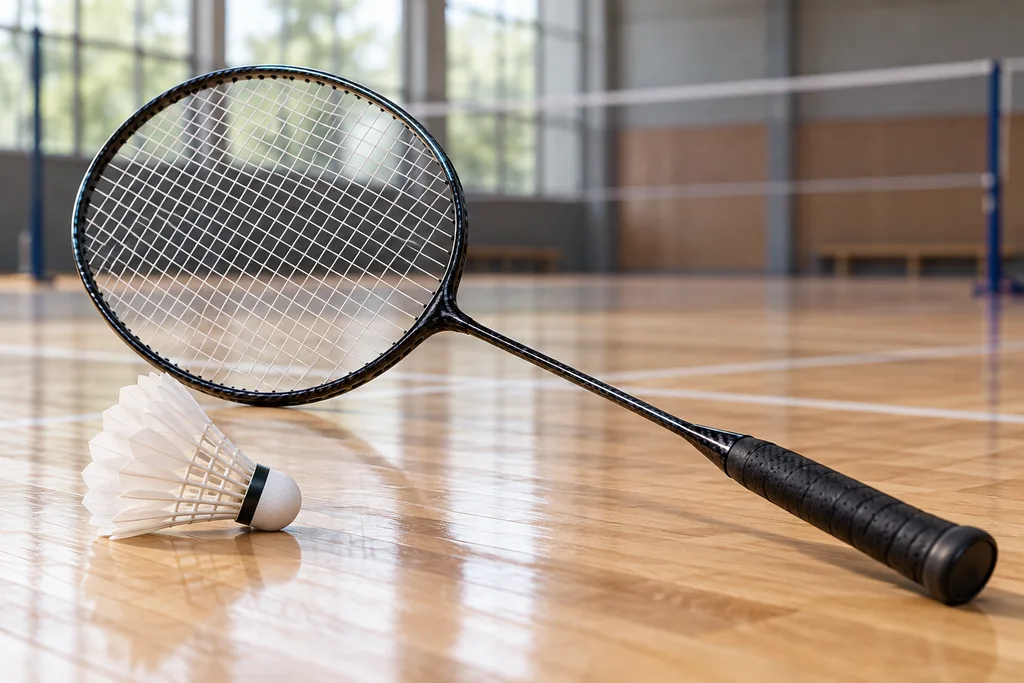
Badminton is one of the sports where carbon composite rackets are most widespread. This section places T700 within the framework of the World Federation's rules. Welcome to the section "Badminton rackets": I will present its outline and its resources.
What organizes the subject
A framework to know: paddles that are already certified remain compliant with the standards of their certification period, despite the arrival of the spin test.
A framework to know: USA Pickleball launched a spin rate test on October 1, 2026; paddles certified after that date must pass it.
Here is what the texts provide: the spin test procedure was released on July 15, 2026; until October 1, a paddle could still be approved with only the surface roughness and coefficient of friction tests.
Note this provision: the strung area of a badminton racket cannot exceed 280 mm in length and 220 mm in width, with a tolerance for the strings to extend into the throat (35 mm wide at most, 330 mm total length).
A framework to know: the laws of badminton limit the racket to 680 mm in overall length and 230 mm in overall width.
The essential concepts, developed
Let us take the time to explain each of these notions, step by step.
Stringing surface
The laws of badminton define the strung area and limit its dimensions, which sets a framework for the size of the hitting zone.
As an example, the Laws of Badminton specify that the stringing forms a delimited surface within the head of the racket. I invite you to continue with the entry Stringing surface.
Shaft
In the regulatory description of the racket, the shaft links the handle to the head. It is therefore one of the elements of the racket's structure.
As an example, the Laws of Badminton name the shaft among the components of the racket. To extend this explanation, go to the entry Shaft.
The vocabulary of the subject
Browse this vocabulary and open the entries that interest you.
- Shaft — the part of the badminton racket that links the handle to the head.
- Stringing surface — the area of the badminton racket occupied by the stringing, intended to hit the shuttlecock.
To go deeper, under the magnifying glass
Open the article of your choice from the list below.
- Carbon frame and shaft: what the T700 mention changes in badminton — find out which parts of a badminton racket are concerned by the announced fiber.
- Permitted dimensions of a badminton racket: the limits of the laws of the game — check in a few measurements that a racket respects the official limits.
The recommended path
Proceed as follows: this process relies on automated equipment designed specifically for pickleball, used in the laboratory and on the court, with proprietary software analysis.
Other useful reference points, up close
Note this figure: the USA Pickleball spin test uses PaddleVision, a two-camera system developed by the Swedish company Image Systems, and sets a threshold of 2,100 rpm that must not be exceeded.
What you can read next
Let us pause on the points below.
- The badminton racket must be free of added objects or protrusions, except those used to limit wear, dampen vibrations, distribute weight, or secure the handle, which must remain reasonable in size and position.
- The strings of a badminton racket must form a pattern of crossed strings, either interlaced alternately or bonded at their crossings.
- The Badminton World Federation (BWF) has authority to decide whether a racket complies with the specifications of the laws.
- A badminton racket cannot include any device that allows the player to significantly change its shape.
Related reading
- Permitted badminton racket dimensions: the limits set by the laws of the game — Check with a few measurements that a racket meets the official limits. Covered in turn: the detailed procedure and the basic vocabulary.
- Carbon frame and shaft: what the T700 label changes in badminton — Learn which parts of a badminton racket are affected by the advertised fiber. The reading plan starts with the essential terms.
- Stringing surface and balance: what the fiber does not say — Avoid judging a racket by its fiber alone while overlooking balance and stringing. The reading plan announced here: the vocabulary to know.
- T700 carbon: what this designation really means — Definition, properties, and a comparison of T700 with other fiber grades. The reading plan announced here: what organizes the subject.
Sources cited
- USA Pickleball lance son test de taux de rotation (The Dink Pickleball) —
- Laws of Badminton, spécifications de la raquette — Maximum racket dimensions (680 mm by 230 mm), strung area, ban on devices that change the shape, authority to rule on compliance. Text consulted as of 2026-10-13.
- Nouveau processus de test des palettes (PPA, MLP, USA Pickleball) — Announcement of March 8, 2023 of a joint automated testing of paddles and balls in the laboratory and on the court. Text consulted as of 2026-10-13.
Sources and verification
- This text draws on 3 sources: 1 official body or institution and 2 press articles.
- Facts checked against their sources on October 13, 2026.
- How sources are chosen and verified: Fact-checking.