T700 carbon: what this designation really refers to
Published on October 21, 2026 Reviewed October 22, 2026 5 min read
Text by the Fibre Tressée editorial team.
Welcome to "T700 carbon: what this designation really refers to." I will guide you from section to section, always telling you where we stand. The goal is to learn that T700 is a fiber grade made by a manufacturer, not a racket label.
The essential terms
Before we move forward, let us define together the words I will use.
String bed
The area of a badminton racket occupied by the strings, intended for striking the shuttlecock.
To make the notion tangible, the Laws of Badminton specify that the strings form a defined surface within the head of the racket.
I refer you to the entry String bed to go further.
Shaft
The part of a badminton racket that connects the handle to the head.
Consider this case to fix ideas: the Laws of Badminton name the shaft among the components of the racket.
You will find the details in the entry devoted to Shaft.
Intermediate-modulus fiber
A category of carbon fibers that are stiffer than standard-modulus fibers, but less stiff than high-modulus ones.
To clarify this term, open the entry Intermediate-modulus fiber.
The detailed explanations
Let us take the time to explain each of these notions, step by step.
Intermediate-modulus fiber
Fiber manufacturers classify their products as standard, intermediate, or high modulus. The intermediate category sits between the other two in terms of fiber stiffness.
To see it at work, Toray's page on standard, intermediate, and high-modulus fibers lets you compare these categories. Find the complete details in the entry Intermediate-modulus fiber.
How it really works
The principle to know: Toray presents standard modulus as the most economical category of carbon fibers in its range.
Keep this basic rule in mind: the T700G is a variant of the T700S with reinforced fiber-resin adhesion; Toray intends it notably for aerospace and sporting goods.
Here is the basic principle to keep in mind: a carbon fiber is a filament about 5 to 10 micrometers in diameter, made mostly of carbon atoms, with high stiffness and high tensile strength relative to its weight. Use this principle as a framework for what follows.
Let us first set out this principle: Toray presents the T700S as a standard-modulus, high-tensile-strength fiber, with processing characteristics suited to filament winding, weaving, and prepreg.
How to proceed
Here is the right reflex: the home page of the International Padel Federation (FIP) does not detail the permitted dimensions or materials of palas; these requirements are found in its regulatory documents, which you should consult directly. Note this advice among your personal reference points.
The criteria that decide
Here is what you need to check: Toray classes the T700G, the version with reinforced fiber-resin adhesion, among the fibers intended for sporting goods; a T700 grade can therefore exist in several variants (T700S, T700G) with different uses. Reread this criterion with your own situation in mind.
Points of caution
A trap awaits at this stage: a standard-modulus fiber is not the stiffest; intermediate-modulus fibers (42 MSi) and high-modulus fibers (up to 85.3 MSi) exist, so "T700" is not synonymous with maximum stiffness. Keep this trap in mind as you continue reading.
What does T700 mean?
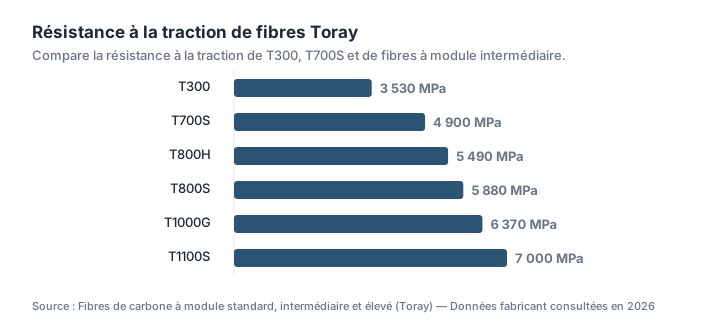
Note this figure: the Toray T700S carbon fiber has a tensile strength of 711 ksi, or 4,900 MPa.
Let us look at what happens here: the T300 is Toray's reference fiber, used in aerospace for more than 20 years; the T700 belongs to the same standard-modulus family.
Let us pause on this measurement: Toray's M series (M35J to M60J) covers moduli from 49.8 to 85.3 MSi (343 to 588 GPa); the T700, at 33.4-34.8 MSi, therefore sits in the lower part of the stiffness scale of Toray carbon fibers.
Possible next steps
Let us rely on this verified value: the tensile modulus of the T700S fiber is 33.4 MSi, or 230 GPa.
Toray standard- and intermediate-modulus fibers
Tensile strength and modulus of a few fibers in the range.
| Fiber | Family | Tensile strength | Tensile modulus |
|---|---|---|---|
| T300 | Standard modulus | 3,530 MPa | 230 GPa |
| T700S | Standard modulus | 4,900 MPa | 230 GPa |
| T700G | Standard modulus | 4,900 MPa | 240 GPa |
| T800S | Intermediate modulus | 5,880 MPa | 294 GPa |
| T1100S | Intermediate modulus | 7,000 MPa | 324 GPa |
Embed this table on your page
For a club, an association, or a blog: the table and its credit, ready to paste.
<table><caption>Tensile strength and modulus of a few fibers in the range.</caption><thead><tr><th>Fiber</th><th>Family</th><th>Tensile strength</th><th>Tensile modulus</th></tr></thead><tbody><tr><td>T300</td><td>Standard modulus</td><td>3,530 MPa</td><td>230 GPa</td></tr><tr><td>T700S</td><td>Standard modulus</td><td>4,900 MPa</td><td>230 GPa</td></tr><tr><td>T700G</td><td>Standard modulus</td><td>4,900 MPa</td><td>240 GPa</td></tr><tr><td>T800S</td><td>Intermediate modulus</td><td>5,880 MPa</td><td>294 GPa</td></tr><tr><td>T1100S</td><td>Intermediate modulus</td><td>7,000 MPa</td><td>324 GPa</td></tr></tbody></table>
<p>Credit: <a href="https://fibre-tressee-l9c0pd.pages.dev/en/dossiers/carbone-t700-ce-que-designe-vraiment-cette-reference-2/">Fibre Tressée</a></p>
Checking a racket advertised as T700 carbon
Points to check before buying, whatever the sport.
- Is the exact fiber grade cited (T700S, T700G...)? — T700 refers to a manufacturer's family of fibers, with variants.
- Does the spec sheet state where the fiber is used (frame, shaft, faces)? — The fiber does not play the same role depending on the part concerned.
- Does the model comply with the rules of your sport's federation? — The regulations apply whatever the material.
- For pickleball, is the paddle on the official approval list? — Approval takes precedence over any mention of material.
- Are the other characteristics (weight, balance, core) detailed? — They affect the feel as much as the fiber does.
In conclusion
Finish by going back over the list to remember, then continue your reading in the neighboring sections.
Related reading
- T700 carbon: what this designation really means — Definition, properties, and a comparison of T700 with other fiber grades. The reading plan announced here: what organizes the subject.
- T700S, standard modulus and intermediate modulus: reading the difference — Place T700S relative to the intermediate or high modulus fibers from the same manufacturer. In these pages, you will go through: the basic vocabulary.
- Pala hitting surface: reading the spec sheet of a carbon model — Decode a pala spec sheet to separate information from slogans. The announced reading plan: the core of the method under the microscope.
- Carbon frame and shaft: what the T700 label changes in badminton — Learn which parts of a badminton racket are affected by the advertised fiber. The reading plan starts with the essential terms.
Sources cited
- Fibres de carbone à module standard, intermédiaire et élevé (Toray) — Presents the T700S and T700G: the T700G offers a higher modulus and better adhesion and targets aerospace and high-end sporting goods. Accessed 2026-10-13.
- Familles de fibres de carbone TORAYCA — Place of the T700 among the standard-modulus (T300, T700), intermediate-modulus (T800, T1000, T1100), and high-modulus (M series) ranges. Accessed 2026-10-13.
- Carbon fibers, Wikipédia —
- T700S, fibre de carbone standard (Toray Composite Materials America) — Characteristics of the T700S fiber: tensile strength 4,900 MPa, modulus 230 GPa, 6K, 12K, and 24K formats. Accessed 2026-10-13.
- Fédération Internationale de Padel — Website of the international padel federation: regulations, competitions, and news. Accessed 2026-10-13.
- USA Pickleball, organisme de gouvernance du pickleball aux États-Unis — Reference body: equipment standards manual, database of approved equipment, news on testing. Accessed 2026-10-13.
Sources and verification
- This text draws on 6 sources: 2 official bodies or institutions and 3 pieces of manufacturer documentation.
- Facts checked against their sources on October 13, 2026.
- How sources are chosen and verified: Fact-checking.